

India’s e-commerce market crossed 150 million online shoppers and is projected to become the world’s third-largest e-commerce market by 2030, according to the India Brand Equity Foundation (IBEF). Globally, the industry is on track to hit $6.09 trillion in 2024, per Statista’s E-commerce Outlook. If you just finished Class 12 or wrapped up your graduation and you’re wondering where the real jobs are, e-commerce is not a gamble — it is one of the fastest-growing sectors hiring freshers right now in India.
The honest truth: you do not need an MBA, a computer science degree, or three years of experience to land your first role. You need the right skills, the right certifications, and a clear understanding of which role fits your background. This guide walks you through exactly that — with a focus on India’s job market, realistic salary expectations, and the shortest path from student to employed.
What Is an E-commerce Career Path and Why It Suits Freshers
An e-commerce career path is a progression through roles that collectively run an online store — from getting products listed and marketed, to fulfilling orders and analysing what’s working. Unlike traditional retail, e-commerce teams are lean. A single specialist at a company like Meesho, Myntra, or a Shopify brand handles work that used to require five people in a brick-and-mortar setup.
That leanness is your opportunity. Companies actively hire freshers into entry-level roles — catalogue executive, performance marketing associate, marketplace analyst — and promote quickly based on results, not years of service. I’ve seen 22-year-olds managing ₹10 lakh/month ad budgets within 18 months of their first job because they learned fast and showed the numbers.
The skill gap in India’s e-commerce sector is real. Platforms like Amazon, Flipkart, Meesho, and thousands of D2C Shopify brands are expanding faster than universities are producing trained graduates. That gap is where you fit in.
The Core E-commerce Roles: Which One Fits You?
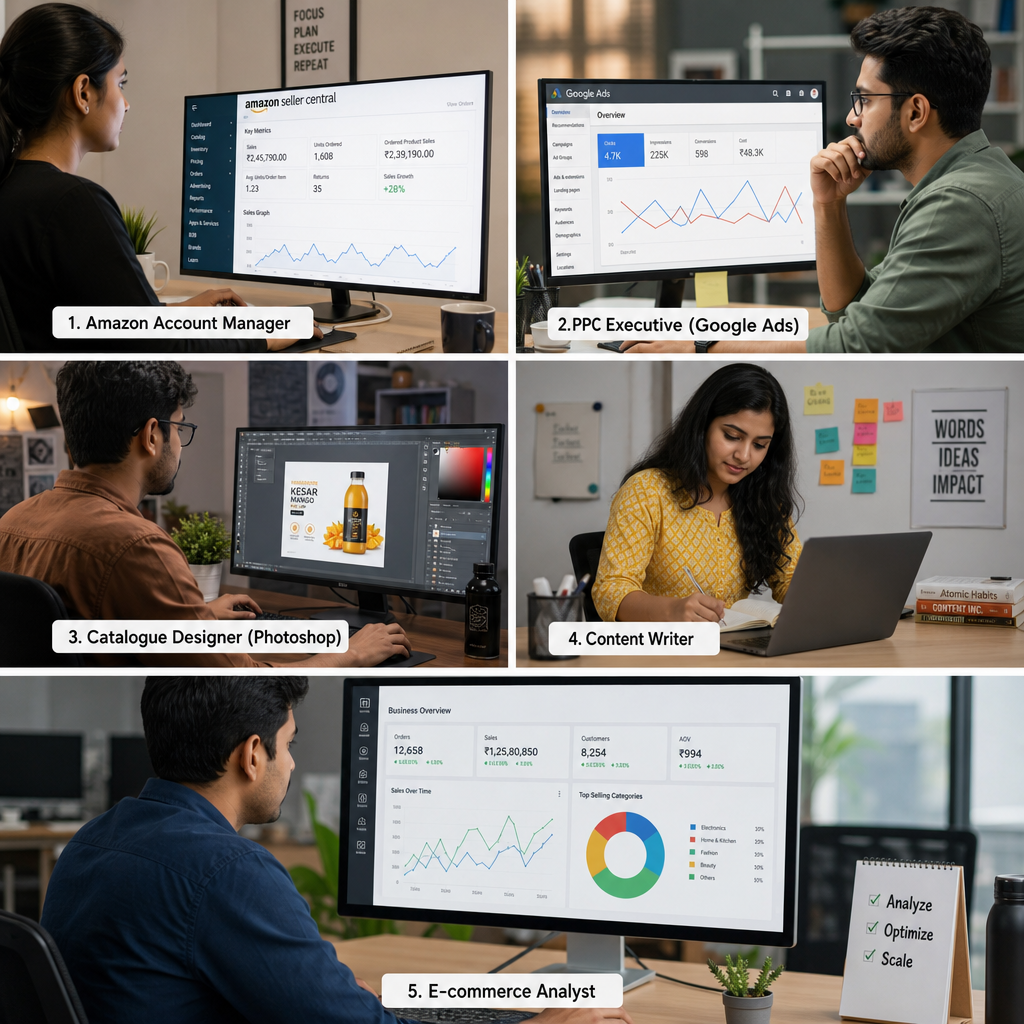
Before you start applying, pick a lane. E-commerce is broad. Trying to learn everything at once leads to knowing nothing well enough to get hired. Here are the five most accessible entry-level tracks for freshers in India.
1. Marketplace Management (Amazon, Flipkart, Meesho)
This role involves listing products, managing inventory, handling seller accounts, and optimising product detail pages. It is the most direct entry point for anyone with basic computer skills and an eye for detail. Companies hiring for this role include aggregators, seller management agencies, and brands selling on multiple platforms.
Skills needed: Excel/Google Sheets, basic understanding of A+ Content, keyword research for product listings, familiarity with Seller Central or Flipkart Seller Hub.
2. Digital Marketing and Performance Advertising
This track covers running paid ads on Google, Meta (Facebook/Instagram), and Amazon Advertising. Entry roles are called performance marketing associate, paid media executive, or digital marketing trainee. This is a data-heavy role — you’ll live inside dashboards, read numbers, and adjust campaigns based on what the metrics say.
Skills needed: Google Ads, Meta Ads Manager, basic analytics (Google Analytics 4), understanding of ROAS and CPC.
3. SEO and Content for E-commerce
Every e-commerce brand needs organic traffic. SEO executives and content writers research keywords, write product descriptions, manage blogs, and build backlinks. This is an excellent entry point for graduates from English, Journalism, or Mass Communication backgrounds.
Skills needed: On-page SEO, keyword research tools (Ubersuggest, Google Keyword Planner), basic HTML understanding, content writing.
4. Catalogue and Creative Operations
Catalogue executives manage product images, write accurate product titles and descriptions, and ensure listings meet platform guidelines. Creative operations roles involve Photoshop, Canva, and basic video editing for social commerce. This suits students from design or commerce backgrounds.
Skills needed: Canva or Adobe Photoshop basics, attention to detail, understanding of platform image guidelines (Amazon, Flipkart, Nykaa).
5. E-commerce Analytics and Operations
Analytics roles track sales data, customer behaviour, return rates, and campaign performance. Operations roles manage logistics coordination, order management systems, and vendor communication. These suit graduates from commerce, statistics, or management backgrounds.
Skills needed: Excel (VLOOKUP, pivot tables), Google Analytics, Tableau basics, understanding of order management workflows.

E-commerce Career After 12th: You Don’t Need a Degree to Start
If you’ve just cleared your Plus Two exams and you’re thinking about skipping a traditional degree — or pursuing one while building skills — here is the practical picture. An e-commerce career after 12th is absolutely viable, especially if you start with a structured training programme or diploma course.
Most entry-level roles in marketplace management, catalogue operations, and social media marketing do not require a specific degree. What employers check is: can you do the work? A certificate from a credible course, a portfolio of two or three practice projects, and a proven internship can get you hired ahead of a plain graduation degree holder with no practical experience.
Recommended Path After 12th
- Enrol in a structured e-commerce or digital marketing course (6–12 months). Look for programmes that include live project work — not just theory videos.
- Complete free certifications in parallel (listed below).
- Apply for an internship via Internshala or LetsIntern within the first 3 months of training.
- Build a small portfolio — a mock Shopify store, a sample product listing optimised for Amazon, or a simple SEO audit of a real website.
- Apply for entry-level roles once you have at least one live project and one certificate.
A Plus Two graduate with a 6-month e-commerce diploma and one internship is more employable in this field than a fresh BA graduate with no practical exposure. The industry rewards proof of skill over paper credentials at the entry level.
E-commerce Career After Graduation: Match Your Degree to the Right Role
If you have a degree in hand, you already have an advantage — your academic background maps directly to specific e-commerce functions. Here is how to make that connection.
Commerce (B.Com / BBA)
Your accounting, costing, and business fundamentals transfer directly into e-commerce operations, seller account management, and financial analytics. Target roles: Marketplace Manager, E-commerce Operations Executive, Category Analyst. Your numbers fluency gives you a real edge in margin analysis and profitability tracking.
Engineering and Technology (B.Tech / B.E.)
Tech graduates can enter as e-commerce platform developers (Shopify, Magento), data analysts, or automation specialists. If you’re not looking for a pure coding role, your analytical thinking makes you a strong candidate for performance marketing and data analytics tracks. Target roles: E-commerce Developer, Analytics Executive, Marketing Technology Specialist.
Arts, Humanities, and Mass Communication (BA / BMM / BJC)
This is where many students undersell themselves. Strong writing, cultural understanding, and communication skills are genuinely scarce in e-commerce teams. Your advantage: you can create product copy that connects emotionally, run brand storytelling on social media, and handle customer communication without sounding robotic.
Target roles for arts and humanities graduates: SEO Content Writer, Social Media Manager, Brand Copywriter, Customer Experience Specialist. A BMM graduate who understands consumer psychology and can write tight product descriptions is more valuable to a D2C brand than a generic graduate who lists “MS Office” as a skill.
Add a content portfolio — three to five real or mock projects with measurable outcomes — and pair it with a Google Digital Garage certification or Meta Blueprint certificate. That combination gets you noticed.
Science (B.Sc. / Statistics / Mathematics)
Your quantitative skills are a direct match for e-commerce analytics, A/B testing, and demand forecasting. Target roles: E-commerce Data Analyst, Inventory Planning Associate, Performance Marketing Analyst. Tools to learn: Google Analytics 4, Excel advanced functions, and beginner-level Python or SQL for data manipulation.
Free and Paid Certifications That Actually Matter
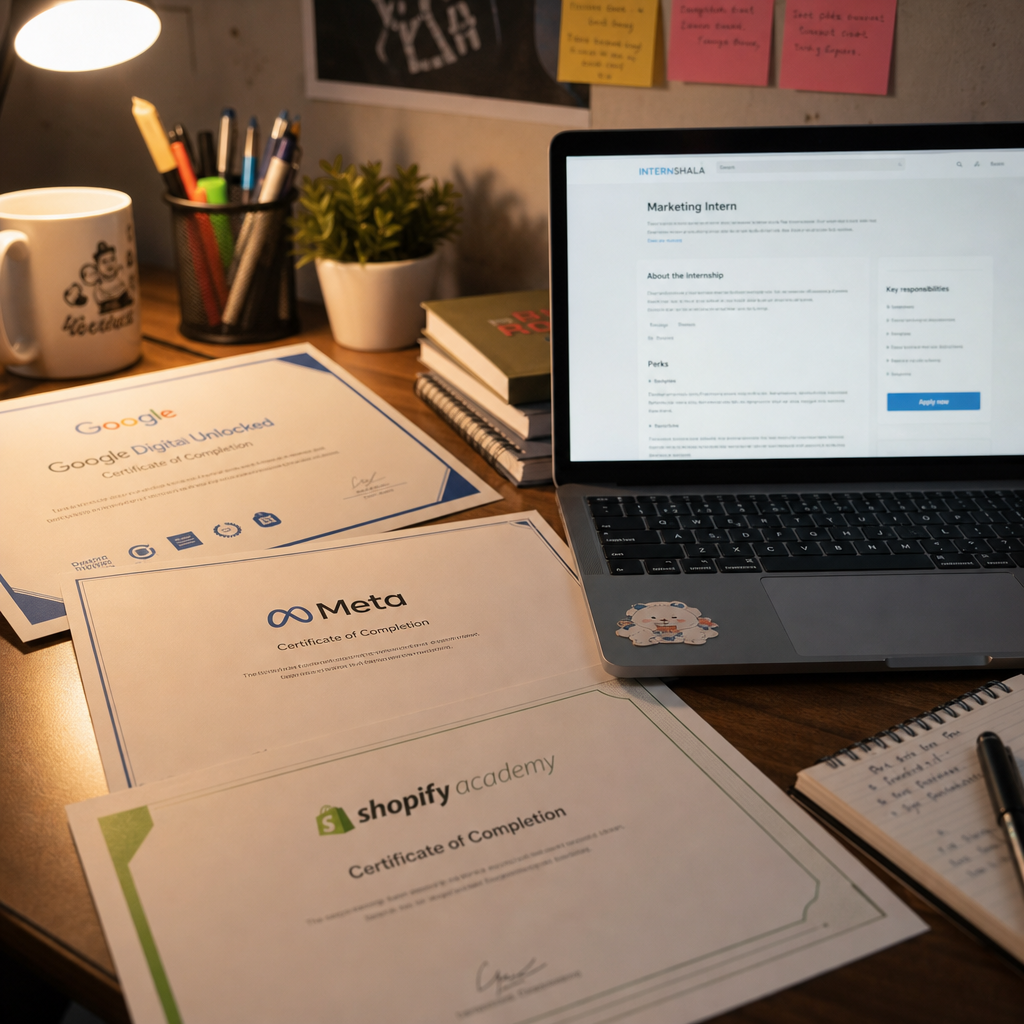
Certifications signal to hiring managers that you took initiative and learned the tools. The best part: many of the most respected ones are completely free. Here are the ones worth your time as you start your e-commerce career.
Free Certifications (Start Here)
- Google Digital Garage – Fundamentals of Digital Marketing: 26 modules, IAB-accredited, recognised by Indian employers. Covers SEO, SEM, social media, and e-commerce basics. Complete this first.
- Meta Blueprint: Free courses on Facebook and Instagram advertising. The Meta Certified Digital Marketing Associate exam costs money, but the learning content is free and highly practical.
- Shopify Academy: Free courses on starting and running a Shopify store, dropshipping, and marketing. Essential if you want to work with D2C brands or launch your own store.
- Amazon Seller University: Free videos on listing optimisation, advertising, and FBA. Available directly in Seller Central. Practical and directly tied to job tasks.
- HubSpot Academy: Free inbound marketing, email marketing, and content marketing certificates. Strong signal for content and CRM-related roles.
Paid Certifications Worth Considering
- Google Ads Certifications (Search, Shopping, Display): Available via Google Skillshop — currently free. The Shopping Ads certificate is highly specific to e-commerce and valued by agencies.
- Semrush Academy: Mostly free courses on SEO and content marketing. The SEO Toolkit certificate is paid but affordable and well-regarded.
- Industry-backed diploma programmes (like the ones offered by Seamedia): Paid, but they combine certifications with live project work, mentorship, and placement support — which free courses alone cannot provide.
Certification tip: Do not collect certificates without doing the work. A Google Digital Garage certificate paired with a mock SEO audit of a real Shopify store is stronger than five certificates with no practical evidence behind them.
Internships: Where to Find Them and What to Expect
Your first internship is your first line on a real résumé. It doesn’t need to be paid or prestigious — it needs to be real work that gives you something concrete to show in an interview.
Where to Find E-commerce Internships in India
- Internshala: The largest internship platform in India. Search for “e-commerce”, “marketplace management”, “digital marketing”, or “Shopify”. Remote stipends for e-commerce roles typically range from ₹3,000 to ₹8,000/month, with in-office Delhi/Mumbai roles sometimes higher.
- LetsIntern: Smaller than Internshala but less competitive for the same roles. Worth running parallel applications on both platforms.
- LinkedIn: Use the “Internships” filter under Jobs. Many D2C brands and agencies post exclusively on LinkedIn. Set up job alerts for “e-commerce intern” + your city or “remote”.
- Direct brand outreach: Find 20 Shopify stores or Amazon sellers in your niche and email them directly. A short, specific email (“I’m a trained Shopify/SEO intern, here’s one improvement I noticed on your product listing”) converts better than a generic application.
What to Do in Your Internship to Get a Full-Time Offer
Show up with a specific goal: learn one skill deeply enough that the company would miss you if you left. In a catalogue role, become the fastest and most accurate product lister on the team. In a marketing role, run one experiment — even a small A/B test on an email subject line — and document the result. Hiring managers convert interns who bring evidence of impact.
Realistic Salary Progression: Year 1 to Year 3
One of the biggest mistakes freshers make is accepting a vague promise of “good pay” without understanding what the market actually offers. Here is a realistic earnings table for e-commerce roles in India, based on data from AmbitionBox and LinkedIn Salary Insights.
- Year 1 (Entry Level — Fresher/Intern to Junior Executive): ₹2.4 LPA – ₹4.2 LPA. Roles: Catalogue Executive, Marketplace Assistant, Junior SEO Executive, Digital Marketing Trainee. Tier-1 cities (Bengaluru, Mumbai, Delhi) skew toward the higher end; Tier-2 cities typically offer ₹2.4–₹3 LPA for the same role title.
- Year 2 (Executive / Senior Executive): ₹4.5 LPA – ₹7 LPA. At this stage, demonstrated results — improved listing rankings, ROAS improvements, reduced return rates — drive compensation more than job title. A performance marketer who can show a 2x ROAS improvement on Meta campaigns can negotiate upward aggressively at the 18-month mark.
- Year 3 (Team Lead / Specialist): ₹7 LPA – ₹12 LPA. E-commerce analytics specialists, category managers, and paid media leads at this stage are in high demand. Companies like Myntra, Nykaa, and growing D2C brands (Mamaearth, Boat, Lenskart) actively recruit at this experience level.
These ranges assume you are actively building skills, not just clocking hours. A Year-2 executive who learned only what their job required grows slowly. A Year-2 executive who completed additional certifications and ran side experiments grows fast.
Building Your Portfolio Before Your First Job
A portfolio is the single most effective way to get hired faster than your competition. You do not need a job to build one. Here are three specific portfolio projects any fresher can create in under 30 days.
Project 1: A Mock Shopify Store
Use Shopify’s free trial to build a functional store around any product category. Add at least 10 products with SEO-optimised titles and descriptions. Set up a basic homepage, collection pages, and a checkout flow. Screenshot the store, write a brief document explaining your decisions, and include it in your portfolio as “E-commerce Store Build — Shopify.”
Project 2: An Amazon Listing Optimisation Case Study
Find a real Amazon product with a weak listing — poor title, thin description, low-quality bullet points. Rewrite it following best practices: keyword-rich title, five benefit-focused bullet points, A+ Content draft. Document the before and after. This shows employers you understand listing optimisation without needing a live seller account.
Project 3: A Mini SEO Audit
Pick any small e-commerce website (not a major brand). Use Ubersuggest or Google Search Console (if you have access) to identify three to five SEO issues — missing meta descriptions, slow page speed, missing alt text. Write a one-page audit document with specific recommendations. This is a direct demonstration of SEO executive skills.
Key Takeaways
- India’s e-commerce sector is actively hiring freshers — the skill gap is real and works in your favour.
- Pick one specific role track (marketplace, performance marketing, SEO, catalogue, analytics) and go deep rather than trying to learn everything at once.
- Start with Google Digital Garage (free), then Shopify Academy (free), then Meta Blueprint (free) — in that order.
- Apply for internships on Internshala, LetsIntern, and LinkedIn simultaneously; expect ₹3,000–₹8,000/month for remote roles.
- Build a three-project portfolio before your first job application — it beats a plain résumé every time.
- Your degree background (Commerce, Arts, Engineering, Science) already maps to a specific e-commerce role — use that connection explicitly in applications.
- Realistic Year 1 earnings are ₹2.4–₹4.2 LPA; by Year 3 with proven results, ₹7–₹12 LPA is achievable in most metro markets.
Your Next Step
The e-commerce career path is one of the most accessible high-growth tracks available to Indian students and fresh graduates right now. You do not need to wait until you have the perfect degree or three years of experience. You need a skill, a certificate, and one real project to show.
If you want to compress that timeline — skip the trial-and-error phase and go straight into structured training with live project work, mentorship from professionals who’ve actually built and scaled stores, and direct placement support — explore what our industry-backed e-commerce training programme offers. With a 95% placement rate and connections to real e-commerce employers across India and abroad, it’s the fastest credible path from student to employed specialist.
You can also browse our digital marketing for e-commerce resources to deepen your understanding of paid and organic channels before you begin. And if you’re curious about which platforms dominate Indian e-commerce right now, our breakdown of selling on Amazon and Flipkart in India gives you the full picture.
The industry is hiring. Start building today.
FAQ
Can I start an e-commerce career right after Class 12 without a degree?
Yes. Most entry-level e-commerce roles — catalogue executive, marketplace assistant, junior digital marketing trainee — do not require a specific degree. A structured 6–12 month training programme, free certifications like Google Digital Garage or Shopify Academy, and one internship are enough to get hired in India's e-commerce market.
What is the starting salary for an e-commerce fresher in India?
Based on AmbitionBox and LinkedIn Salary Insights data, entry-level e-commerce roles in India pay ₹2.4 LPA to ₹4.2 LPA in Year 1. Tier-1 cities like Bengaluru, Mumbai, and Delhi offer higher ranges. By Year 3 with demonstrated results, salaries in specialist or team lead roles can reach ₹7–₹12 LPA.
Which free certifications should I complete to start an e-commerce career?
Start with Google Digital Garage's Fundamentals of Digital Marketing (free, IAB-accredited). Then complete Shopify Academy (free) and Meta Blueprint (free learning content). These three together cover SEO, paid advertising, and store management — the core skills most Indian e-commerce employers look for in freshers.
Where can I find e-commerce internships in India?
Internshala and LetsIntern are the top platforms for e-commerce internships in India. Remote stipends typically range from ₹3,000 to ₹8,000 per month. LinkedIn is also effective for D2C brand and agency roles. Direct cold outreach to Shopify stores and Amazon sellers via email can also generate internship opportunities that aren't publicly posted.
Does my degree subject affect which e-commerce role I should target?
Yes, and you should use it deliberately. Commerce graduates (B.Com/BBA) suit operations and analytics roles. Engineering graduates fit developer and data analyst tracks. Arts and mass communication graduates are strong candidates for SEO, content, and brand copywriting roles. Science graduates with statistics skills excel in performance marketing analytics and demand forecasting.
Do I need coding skills to work in e-commerce?
Not for most roles. Marketplace management, digital marketing, SEO, catalogue operations, and analytics roles require no coding. If you want to work as an e-commerce developer on platforms like Shopify or Magento, basic HTML/CSS and Liquid (Shopify's templating language) are helpful — but the majority of e-commerce jobs in India are non-technical.
How long does it take to land a first e-commerce job from scratch?
With a structured approach — a focused 4–6 month training programme, two to three free certifications, and one internship — most freshers can land their first e-commerce role within 6–9 months of starting. Building a portfolio with real or mock projects alongside your training significantly reduces this timeline by making you stand out in applications.